The Brickabrats Release Debut Single & Video “Fun Night”
Portland, OR's The Brickabrats have released their debut single and video, Fun Night, that was mixed by Mark Kaeder with…


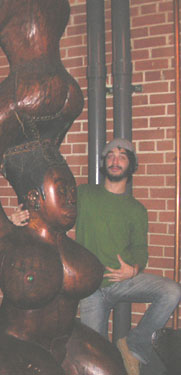
Protest The Hero‘s very own Arif was nice enough to take some time out of his day to sit and answer some questions as his band passed through Edmonton during their Tour and Loathing Tour. He received some help from Rody for a few of the questions as we sat in a front of a large wooden statue of a naked man sitting on a naked woman, which seemed to attract everyone’s attention that evening. Anyway, the interview went well, and like always, I learned some new things about the band. I’d like to thank John for setting it up and Arif and Rody for doing it.
Bobby: You guys are a couple days into this “Tour and Loathing Tour”, are you excited to see how it turns out?
Arif: Absolutely. First of all, I have to mention I absolutely despise the name “Tour and Loathing,” we have nothing to do with it. That was our management’s blunder. But yeah, we’re having a great time. It’s good to be back in Canada where the faces are familiar. *Rody comes in* Ahh Rody joins the crew! But yeah, it’s good to be back in Canada, the faces are familiar and we’ve been looking forward to this tour for a really long time. And it’s a good break from what we have been doing, which is building new enterprises in foreign countries or whatever. I don’t know – it’s good to be back. We’re only two days in, but I think it’s gonna get wild.
Bobby: Who came up with the band list? Because there’s quite a few bands, five bands, how did you pick who you wanted to open for you guys?
Rody: We really had nothing to do with it really. We were out on the road just doing a week of shows and this tour came together without us at all. Our management just put together this packaged tour.
Arif: There was good news as well. We found out that a friend of ours, Brian, who used play with The Fullblast, who unfortunately broke up, is playing bass for A Wilhelm Scream. Which is great cause I admire him as a musician and as a dude, so it’s good to be back on the road with him. So there’s little surprises, and I’m sure they’re all gonna be really friendly.
Bobby: Last week was a big week for you guys. On the 4th, Kezia was finally released in the US, are you excited to finally have it out there?
Arif: We’ve kinda been through the release thing in Canada, so yeah, it’s good to have an album out there, but I don’t think we’re particularly excited about it.
 Rody: This is how I’ve been explaining it. It’s like when you’re having your birthday party, like a pool party in your backyard and all your friends are there. It’s just a small sort of get together but it’s really fun. And then later on, you go to like the Civic Center where there’s a whole bunch of kids there that you don’t know, and it’s not quite as exciting. That’s sort of like our American release.
Arif: I would have to agree, I would have to agree with him.
Bobby: That’s a good analogy.
Arif: Or like celebrating your birthday after your birthday. “I’m having my party in a week.” But no, it’s good. It’s nice to know that there’s three hundred million people who now have access to our record where as they didn’t before. It’s such a huge new market and such a huge new audience that we’re just trying to tackle it as efficiently and effectively as possible. But yeah, it’s good times.
Bobby: It was released through Vagrant Records, how did you guys meet up with them?
Rody: Well, we were shopping it around in the States, and they were one of the labels that we shopped it too. They flew us down to L.A., we meet up with those guys, they took us out to dinner. They were just very genuine people, nice beyond belief. It didn’t seem like a business in any way. It didn’t seem like a company, didn’t seem like a collected group of pros who were going to help each other out.
Arif: Yeah, I think out of all the labels we met and talked to, I think Vagrant was the only one we felt really comfortable with on a personal level. None of us are particularly industry savvy, so we really look for relationship with people where we can just chill with them and they’re people that are approachable and that we can talk to. On top of that, they were really excited about the record. They seemed to have the most sincere excitement and enthusiasm for promoting our record, so obviously we were going to go with them. We hope for the best, but it’s been good, good times with them.
Bobby: Is there a big different with Vagrant compared to your Canadian label Underground?
Rody: Oh absolutely.
Arif: The similarities are that there’s a connection of friend or people that we consider friends. The difference is that Vagrant operates, obviously, on a much larger scale to a much larger audience and they have an infrastructure built to support that. Whereas Underground Operations is a lot smaller, it’s more just like a Toronto based thing that’s extended into the rest of Canada. But it’s nothing like Vagrant in anyway. And it has to be that way. They’re playing in a different field; they’re playing the same game but in a different league.

Bobby: I don’t know if it’s like this in the American release, but on the Canadian release, in the booklet you have four stickers. Why did you decide to put those four stickers in?
Arif: It’s about interaction. Only the first pressing, the first 500 or something, had those stickers in them. And it was just to give the people who had the record a sense of connection with it, more of infinity to the record by actually taking part in the artwork, it’s unique and it’s personalize in that way. We haven’t heard of any bands doing anything like that, so we thought it would be a nice little perk for the people who went out and bought the album first, for the people who knew us first, before the other.
Bobby: The album, which isn’t a concept album, more of a storyline which depicts the story of a girl from three different perspectives. How did you guys come up with that idea?
Arif: The structure of the idea was just to accommodate the fact that it wasn’t really a story in that it wasn’t a sequence of events in any kind of chronological order. When you’re not using one linear dimension, you’re actually considering the fact that you have three perspectives then it only made sense to… We’re trying to highlight personalities and highlight characters, not necessary tell a story. But the structure of it had to be different and that’s why it’s three songs, three songs, three songs and then a final statement which is effectively the closest thing to our voice that’s on the record. Closest thing to our older songs anyway.
Bobby: Was it hard to keep it flowing in that same direction, with the three perspectives?
Rody: I don’t think it was difficult at all. I think it came very naturally to us. We wrote the songs all out of order, and then when we came and actually had the physical manifestation of the songs, they just worked. They worked very well. Because I think we wrote the songs based on the intensity and the meaning of the lyrics.
Arif: Yeah, you can take an atmosphere, or if you have the theme beforehand, then the music that you write around that theme is different and is very based on what you were trying to communicate. So yeah, we wrote it completely out of order, but then the album is not necessarily meant to be listened to in order. This is what I was talking about earlier about backgrounds and different dimensions. That its not linear, you can listen to track one and then skip to track seven and then find and draw parallels which would be impossible if it was a concept album in the sense that it is telling a story in chronological order. So yeah, it wasn’t difficult, no, because we knew the motif that we were trying to express.
Bobby: I know it’s not a concept album; you guys hate it when people call it that, but you can’t deny that lately a lot of people are going towards the concept album idea. Green Day, Armor For Sleep, Dredg, and so on. Why do you think so many bands are going towards that direction?
Arif: Well, I think music in general is pushing forms, pushing conventions, and it only makes sense that lyrics would follow suit. And I think that when faced with the option of doing a record that is one unit as opposed to ten or twelve independent units, that’s an attractive option for a lot of bands to explore. Because, hey, people haven’t exactly been doing it the past. And that’s why concept albums or “conceptually” based albums in anyway are sprouting up. It’s not that we have to differentiate ourselves from that or shy away from it. Yes, we’ve done a conceptually based album and we’re fine with that, it’s just that people have a very old school way mentality with what a concept album is, an incredibly geeky thing that the band took very, very seriously. At the end of the day, we don’t take ourselves that seriously. We’re not trying to create an art, we’re just creating. We’re happy if someone happens to extract meaning from that or someone sees more inside than that, then we thank them, we thank them; but that’s not what we were trying for. We’re not artists by any stretch of the imagination.
Bobby: You guys started the band when you were 14, but unlike a lot of people who start bands at that age, you were able to keep it going. How do you think you’ve been able to keep going so long?
Arif: Probably just luck to be honest with you. Really early on we met our present-day manager, Mark London Spicoluk, who has shown a crazy amount of dedication and devotion to the band. He was the first person to take what we do seriously and see a potential career in it, well before we did and certainly well before our parents did or anything like that. We always had a backbone to land on, we were recording, we were doing something, so we just never stopped. And  then somewhere in there, I guess things became a little more professional. It really doesn’t come down to a single moment where everything changed; it’s just been the right people at the right time from the beginning. It’s been a journey so far.
Bobby: Like you just said your parents did see this as a career right away, what did your parents say when the day you finished your high school exams you went on a three week tour?
Bobby: Do you have any advice for bands who are just fourteen, fifteen and just starting up?Arif: I think that was a cumulating point. They had seen us doing band activity a little more frequently then say other kids and their bands. We were taking it a little more seriously than other bands were. So when high school ended, I think it was easy for them to accept that we weren’t going to post-secondary because we had an avenue that we could explore that was really unique and if you were granted opportunities, like certain ones that we had been; ie. Going on tour and ie. Having the experiences that we’re having – you’d be a fool not to take it. And there’d be a lot of people who tried and failed that would be very upset with you for not taking it. So for all those bands that we grew up playing with that, because of school or because of whatever reason, had to breakup, we felt compelled to continue touring as long as we can. But I don’t know, it comes down to something like that. Our parents have never really been a big problem; they’ve always been very supportive from the beginning and it’s been a long time.
Arif: Don’t hop into recording things. The recordings will always come back to haunt you, and you’ll have a core audience that loves them but you, yourself, will hate and despise them. Also, don’t take yourself very seriously, but take your craft very seriously. But other than that, I’m not someone to seek advice from because I’m in the middle of it myself, and having wisdom when it comes to what it is to be a musician, further more what it’s to be a traveling musician, I’m on the beginning end of things.
Bobby: Okay, I love going to concerts. I try to go to as many as I can, but of course there are always some which are a bit more memorable than others. So thinking back, what are some concerts that you went to that are really memorable for you?
Arif: Recently, I guess it’s not recently; it was a while ago, I saw Damien Rice in Toronto at Convocation Hall – the University of Toronto lecture hall. I think the environment and the sincerity of that set really stood out for me as a fantastic show. I love seeing Death By Stereo live, I love seeing The Fall Of Troy live, Into Eternity from Saskatchewan put on a great show. In terms of memorable experiences, a lot of things have to come together. The band has to be playing just right, the music has to be just right, the company has to be just right, the venue has to be just right, the atmosphere has to be just right, the vibe has to be right and the night itself. When all those elements do come together, it makes for a very special evening, and that’s the memorable factor about it. And sure I’ve had a ton. I think Damien Rice has been the big one for me though. Not that I listen to a lot of mellow music or acoustic music or anything, the way he makes a room feel is an intangible element of musicianship that can’t be learned and can’t be taught, only can be experienced and only can be intuitively felt and I really felt it at that show.
Bobby: Okay, if you could tour with one person or band, dead or alive, still going or broken up, whatever, who would you choose to tour with and why?
Arif: Dead or alive? Oh man, you’re asking a really tough question. I would like to go back to the early ‘80s and tour with old Metallica because they had a really good time and they had Cliff Burton on bass. Yeah man. There’d probably be a lot, if I put some thought into it I’m sure I could come up with something really cool. But certainly old Metallica, because those guys looked like they had a good time before they pussied out on the universe.
Bobby: Now onto a bit more unusual questions that I just like to ask at all my interviews to keep it interesting.
Arif: Sure man, go for it.
Bobby: First off, if you guys, as a band, were stranded on a desert island with no food and nothing to eat, which one of the band members would you eat to survive and why?
Arif: I would eat Luke to survive because he’s undoubtedly the cleanest among us and he has some muscle on his body and I think it would taste good. I wouldn’t eat Tim because he’s disgusting and fucking diseased, I wouldn’t eat Rody for the same reason. Actually, you know what, come to think of it; I’d eat Moe because I don’t like him.
Bobby: If you were the member of the opposite sex for a day, week, month, however long you wanted, what would you do and why?
Arif: I would touch my pussy all day long and then lick my fingers.
Bobby: Okay, could you tell us something about the band or one of its members that not many people know about? Like a little quirk they do on the road or something like that?
Arif: Luke gets really drunk and wets the bed a lot; it’s turning into a problem. If it happens again we’re resorting to diapers or Depends or something. But yeah, it’s turning into an issue. He pissed in the van and it smells. So watch out world, don’t buy him beer if you’re coming out to the show; it’s deadly for him.
 Bobby: Okay, if you could have one thing at this moment, anything at all, what would you have and why?
Arif: What would I have? A blonde with a million dollars in her gouch.
Bobby: I guess we can end with an easy question – tomorrow’s Easter, are you doing anything to celebrate?
Arif: We asked the venue to hook up an Easter Egg hunt for us, but I don’t know if they’re going to. If they do, I’m going to be hunting for eggs all afternoon. If not, I’m just gonna wait ‘till the next day and buy a lot of clearance chocolate and just gorge myself on it.
Bobby: I guess that’s about it, do you have any final thoughts?
Arif: Nah, just thanks very much for the interview, I hope you enjoy the show.
Bobby: It should be fun; I’m looking forward to it.
Arif: Try and describe a visual of this fucking thing. I would like to see how that comes on to paper.
Bobby: I’ll take a picture of it and throw it up on with the interview.
Arif: Please do. That’s on our rider by the way.


The Doll Hut, Anaheim, CA - 11th July 2026